
Social Theory of Vygotsky
FQA
⦁ Who gave the theory of social development?
⦁ What is Vygotsky’s theory of learning?
What are the characteristics of Vygotsky’s theory?
⦁ What is ZPD according to Vygotsky?
⦁ How do children learn language according to Vygotsky?
Table of Contents
Lev Vygotsky Theory of Cognitive Development
- Vygotsky (1896–1934) was a Russian psychologist. Who did the rendering of socio-cultural theory. Vygotsky’s socio-cultural theory is called.
- Vygotsky’s socio-cultural theory is also called ZPD (Zone of Proximal Development).
- Vygotsky was a creative thinker who explained the cognitive development of children on the basis of social and cultural theories.
- According to Vygotsky, the child learns through imitation or interaction while living in society and culture. Child needs proper guidance or direction and good family etc. for learning or their mental development and children get this guidance from society and culture. According to him, the child develops himself by interacting with the society. Vygotsky propounded his theory keeping the society at the center.
- According to this theory of Vygotsky, the development of the child is done by the society. Vygotsky gives an important place to both social and cultural theories in the all-round development of the child, due to which Vygotsky’s theory is also known as socio-cultural theory.
Vygotsky’s socio-cultural theory pdf
- Vygotsky considers these three concepts important in the cognitive development of the child.
- social interaction
- language and
- Culture
- These three concepts are the basic foundation of Vygotsky’s cognitive development theory, that is, he explains his theory completely on the basis of these three.
Lev Vygotsky Theory Pdf Download In English
- Social Interaction:
According to Vygotsky, children develop their cognitive development after receiving directions from society and they learn this process of development by imitating their society. - Language : –
Vygotsky considers language important for cognitive development. With the help of which the child interacts with the society and culture. According to Vygotsky, if a person does not know the language, then that person cannot develop his cognitive development (his knowledge).
According to Vygotsky – “Communication with others is an important factor in a child’s language development.
| According to Noam Chomsky’s, there is a device in the brain of every person to teach and understand language, which is called Language Acquisition Device, or LAD. Pay attention to what Chomsky said. |
- Culture:-
Culture has its own important contribution in Vygotsky’s theory. Children develop their moral values in culture. Which inspires man to behave decently and the child also learns all this through imitation.
Vygotsky Theory in Hindi
| 3 Important Concepts |
vygotsky theory 3 Important Concepts
1.MKO (more knowledgeable other) – Parents, elder siblings
2.(Scaffolding) Reading / Framework / Scaffolding – Temporary help given by MKO.
3. Z PD (Zone of Proximal Development)
1. MKO:- More Knowledgeable Other
- (More Knowledgeable Other) refers to a person who has more knowledge, experience and skill than the learner.
- At the MKO level, a person gets solution to his problems through his parents, elder siblings, friends or any of his relatives.
- According to Vygotsky’s socio-cultural theory, if the learner has more intelligence than the teacher or has the same intelligence, then in such a situation the cognitive development of the child will not be done well.
- That is, for the cognitive development of the child, it is necessary for the person teaching to have more knowledge than the person learning. This is called Vygotsky’s More Knowledgeable Other (MKO).
2. Reading / Framework / Scaffolding
- Scaffolding: Providing temporary help to children through their teachers, friends or any of their relatives or parents of the child is called Scaffolding. Due to which the child can do that work easily.
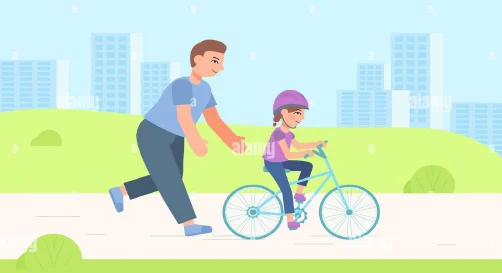
- For example, when a child learns to ride a bicycle, his father or brother-sister who helps the child for some time is called Scaffolding.
3. Zone of proximal development (ZPD)
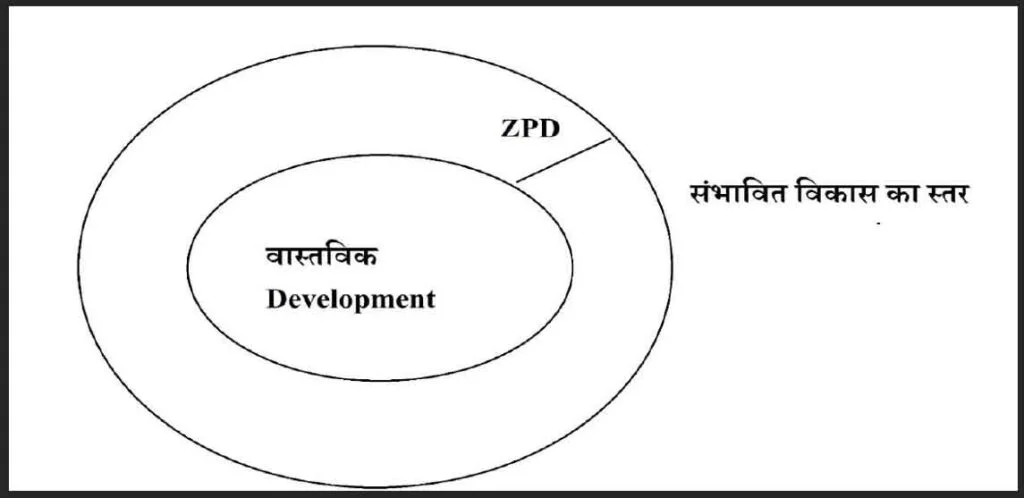
- Zone of Proximal Development: The gap between the level of actual development and the level of potential development is called the zone of proximal development.
Vygotsky’s thoughts on language
According to Vygotsky, the child creates his own knowledge.
⦁ Vygotsky said that language comes first, thought comes second.
⦁ According to Vygotsky, language and thinking are initially separate, later
⦁ According to Vygotsky, language and development happen together in the child.
⦁ Language facilitates cognitive development.
⦁ Vygotsky has given a lot of emphasis on language.
⦁ Vygotsky said that society and culture are important for the cognitive development of the child.
⦁ According to socio-cultural theory, social interactions, language and culture are important for the cognitive development of the child.
⦁ According to Vygotsky’s socio-cultural theory, learning is necessary for development.
Characteristics of Vygotsky’s Theory
- According to Vygotsky, first learning or first learning is essential for development.
- According to Vygotsky, the qualities of cognitive development are already present in the child, but to bring out these qualities, Vygotsky’s theory gives an important place to the society and culture for the cognitive development of the child.
- Vygotsky considers social interaction, social interaction with language and culture to be very important for the cognitive development of the child.
- Vygotsky considered the concepts of ZPD, MKO and Scaffolding to be essential to student learning.
Difference Between Vygotsky’s Theory and Piaget’s Theory
- Vygotsky’s theory emphasizes the importance of society and culture for a child’s cognitive development, while Piaget’s emphasizes age for cognitive development.
- According to Vygotsky, first thoughts arise in the child, later on language Piaget believes quite the opposite.
- Vygotsky was a person with social structural thought and Piaget was a person with cognitive structural thought.
- Vygotsky considers guidance necessary for learning and Piaget considers learning as a part of self-activation.